Just before the autumn colours begin in earnest, Uirimji in September is quietly unhurried. It sits in that gap between peak summer and peak foliage — not yet on most visitors' radar — which means you can walk the ancient waterside almost entirely to yourself.
Why September
By October, Uirimji draws crowds as one of Jecheon's prime autumn-foliage spots. September is different. The first cool breezes of early autumn arrive, and the deep summer green is just beginning to shift. Visitor accounts consistently describe September as "the threshold before the colour turns" — an apt description. Midday sunshine is still warm, but when the wind passes over the reservoir surface you can feel the border between summer and autumn. Come at dawn or early morning and the temperature gap between night and day generates a low mist that drifts between the Jerim pine trees, lending the place an entirely different atmosphere.
What to See: Uirimji and Jerim Forest
Uirimji is believed to have been constructed during the Samhan period, and it appears by name in major historical records including the Samguk Sagi, Goryeosa, and the Veritable Records of King Sejong (Sejong Sillok). Together with Byeokgolje in Gimje and Susanje in Miryang, it is counted among the three great ancient irrigation works of Korea — and remarkably, it still supplies agricultural water to the fields below. That it functions as a living irrigation system rather than a museum artefact is what sets Uirimji apart from an ordinary scenic site.
A walking path follows the perimeter of the reservoir along a gently graded wooden boardwalk, accessible to visitors of all ages and fitness levels. A leisurely full circuit takes about one hour. Bridges at several points along the route allow you to cut the walk short and adjust the distance to suit your energy.
Jerim is the forest that lines the reservoir's edge — old pines forming the backbone, with willows, ginkgo, and cherry trees woven among them, casting reflections onto the water. The landscape encompassing both Jerim and Uirimji was designated a National Scenic Site (Myeungseung) by the Korean government in 2006. Along the path you will also encounter traditional pavilions such as Yeonghojeong and Gyeonghortu, and historic features including Yeonjaam and Yongbawi (Dragon Rock).
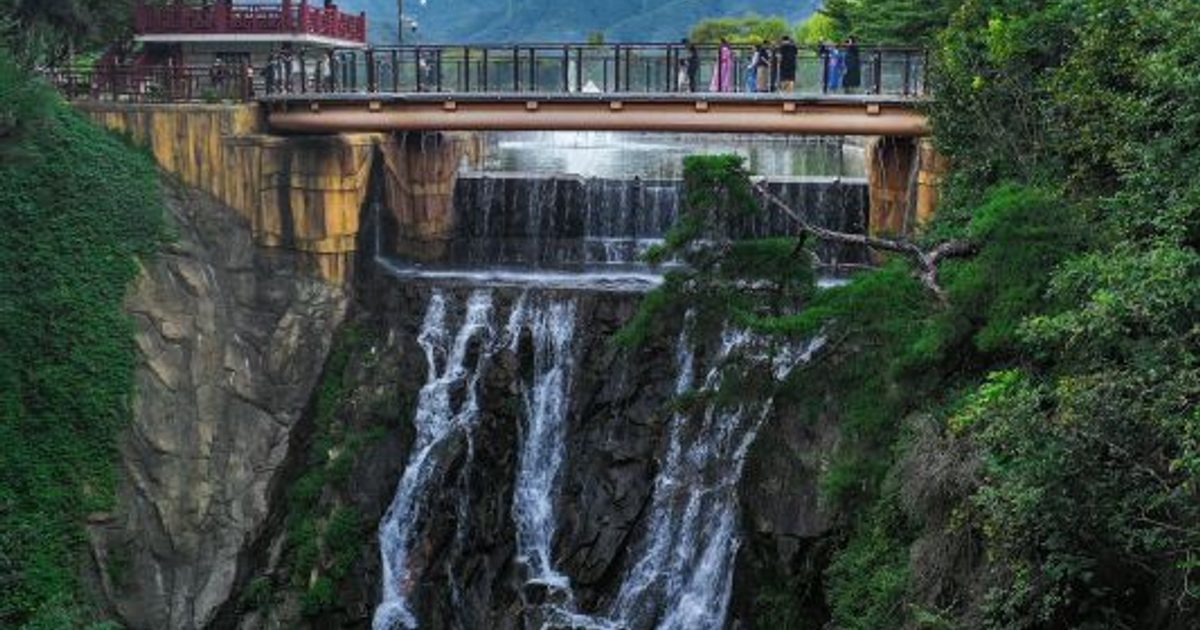
At the northern end of the reservoir stands Yongchu Pokpo (Yongchu Waterfall). Above the falls, a glass-floored observation deck extends outward so you can look straight down at the water dropping below you. In September the surrounding foliage is still a lush green, giving the waterfall area a fresh, vivid quality.
Getting There and Practical Information
The free public car park address is 181 Mosan-dong, Jecheon-si, Chungcheongbuk-do. The reservoir is directly in front of the car park; additional parking is also available beside and within the site. Admission and parking are both free. The site is open 24 hours a day, year-round.
By public transport, take a city bus from Jecheon Station or a taxi; either option takes roughly 10 minutes.
Visitor Tips
The Jecheon International Music Film Festival is held in September, so pairing a walk at Uirimji with festival screenings makes for a well-rounded day trip or one-night itinerary. After the walk, popular extensions include the herb-medicine street (yakchogeori) in central Jecheon and the Cheongpunghoban Cable Car.
To avoid the busiest hours, aim for an early morning visit. Uirimji in the mist of early morning offers a stillness quite unlike the afternoon. Once peak foliage arrives in October, weekend congestion increases noticeably — so for a quiet, unhurried walk, September is in practice the most favourable window.